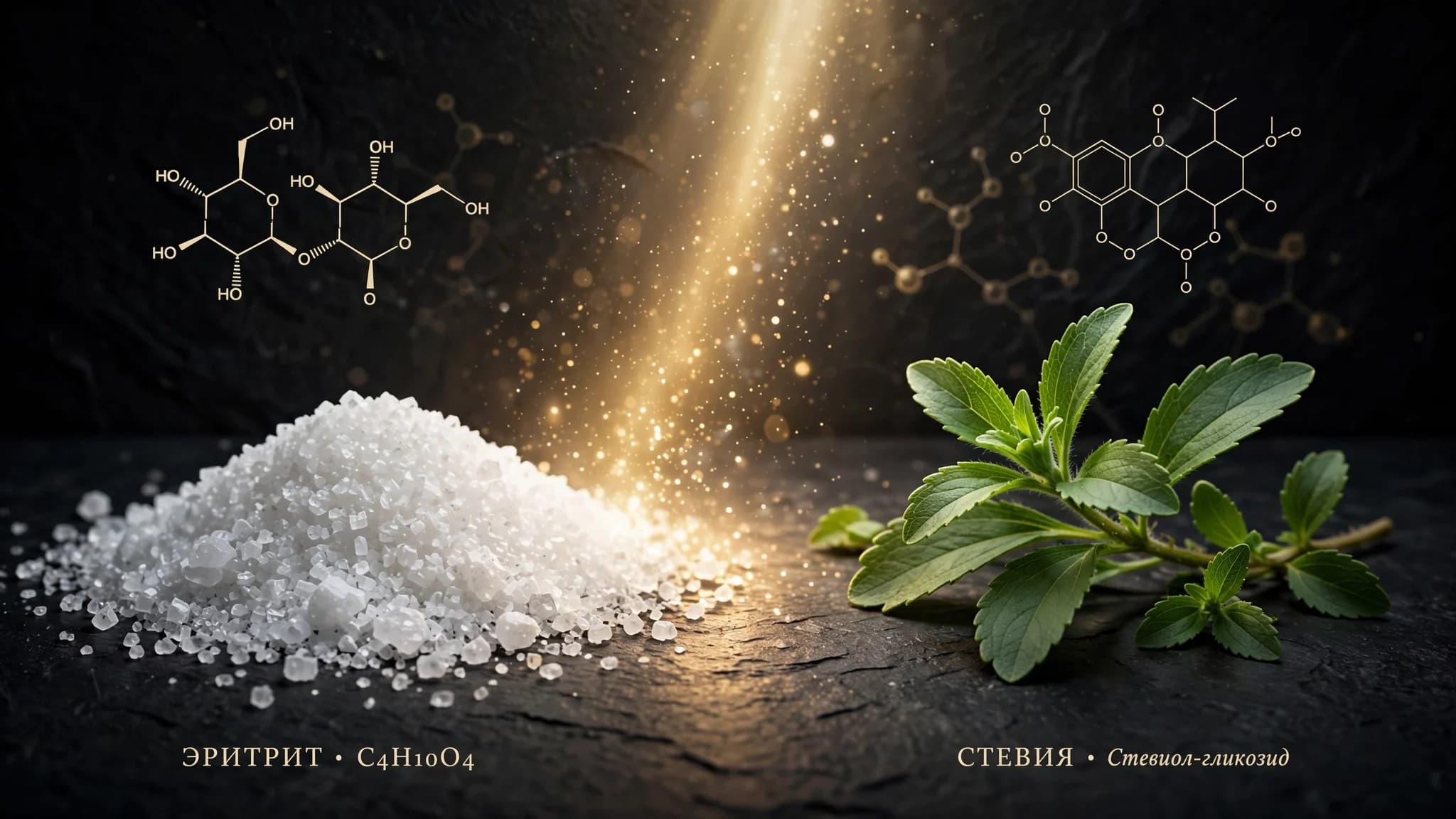
Sugar substitutes: erythritol and stevia

Erythritol and stevia are allowed: they do not raise blood sugar and do not count toward the daily carbohydrate allowance. But there is one caveat that the method does not ignore: the sweet taste itself reinforces the habit of eating sweets, so keto desserts every day work against you.
What is the difference between them?
Erythritol is a sugar alcohol, with a taste closest to sugar and a slight cooling sensation in the mouth. Stevia is a plant extract, dozens of times sweeter than sugar, with a herbal aftertaste that not everyone likes.
Erythritol is more convenient for baking: it provides volume. You need only tiny amounts of stevia, and it is easy to overdo it — then bitterness appears.
Both can cause bloating in large amounts, more often erythritol.
What should you choose for your purpose?
| Erythritol | Stevia |
|---|---|
| Taste | close to sugar, cooling sensation |
| Volume | provides it, suitable for baking |
| Tolerability | bloating in large doses |
| Where it is more convenient | desserts, drinks |
Which substitutes should be avoided?
Those that come in ready-made “fitness” products together with something else.
Store-bought bars, protein cookies, and “keto chocolate” usually contain not only a substitute, but also syrups, starches, and maltitol, which does raise blood sugar. You need to read the ingredients more carefully here than on regular products: the words “sugar-free” on the package guarantee nothing.
Honey, agave syrup, and coconut sugar are not substitutes at all — they are sugar under a different name.
What instead of dessert?
Dark chocolate, 85% or higher, 10-20 g. This is a daily ceiling, not a target, but it settles the question of “wanting something at the end” without any special ingredients.
The second option is a small amount of berries. They fit within the 50-70 g allowance if you keep track of the amount.
The third is not a dessert at all, but a last meal of a normal size. An evening craving for sweets most often means that you did not eat enough during the day.
What do people most often get wrong?
- Switch your entire usual intake of sweets to substitutes and wonder why the craving does not go away
- Believe the “sugar-free” label instead of checking the ingredients
- Consider honey and agave a healthy replacement
- Eat keto bars between meals
- Overdo stevia and decide that substitutes taste bad
When this is not suitable
With irritable bowel syndrome, sugar alcohols, including erythritol, are often poorly tolerated and cause bloating and diarrhea.
With diabetes, switching from sweets to substitutes does not eliminate the need to monitor glucose and is not a reason to change treatment on your own. With eating disorders, any rituals around sweets are best discussed with a specialist.
Children and adolescents do not need substitutes without a specific reason.
What is maltitol and why is it singled out?
It is also a sugar alcohol, but it behaves differently from the others: it noticeably raises blood sugar.
The problem is that maltitol is the most common sweetener in commercial “keto” and “diabetic” products: it is cheap and has a texture closest to sugar. A bar labeled “sugar-free” that contains maltitol may produce exactly the effect you bought it to avoid.
The second issue is tolerability. In amounts provided by one or two bars, it often causes bloating and diarrhea.
How much can you have?
There is no strict limit in the method because the issue is not grams, but frequency.
Occasional use — a cup of coffee with stevia, a dessert for a celebration — changes nothing. A daily keto dessert in the evening does: it maintains the ritual of having something sweet at the end of the day.
The guideline is simple: if you cannot remember a day without a sweet taste during the past week, substitutes have stopped being a tool and have become a habit.
Do they affect cravings for sweets?
There is not enough direct evidence that substitutes themselves increase cravings, so this cannot be stated as a fact.
But there is a simpler reason for the method’s caution: something sweet at the end of the day is a learned sequence. While it is repeated, it remains in place. By changing the content of the ritual, you do not change the ritual itself.
That is why the recommendation is not a ban, but an order: the first month without a sweet taste, then as needed.
What to read next
How the approach works as a whole — on the main page low-carb eating: the complete guide.
The other materials in the section are collected here: food and shopping.
Related topics: Vegetables that grow above ground and Avocado every day: why and how much.
Reviewed by Anastasia Zhukova, Fitness Trainer • Author of a Nutrition and Training System • Creator of an AI Personal Support Platform
A human has reviewed this material against the method and real client practice.