
Low-carb diet: complete guide

Low-carb eating is eating where fat, not sugar, becomes the main fuel. A maximum of 50–70 g of carbohydrates remains per day, fats make up 70–80% of the diet, and food fits into two or three meals with no snacks between them. There is no need to count calories: what matters is the composition of the plate.
50-70 g
of carbohydrates per day
70-80%
of the diet are fats
1.2-2 g
of protein per kg of body weight
8-10 h
eating window
What is LCHF in simple terms?
LCHF stands for Low Carb High Fat: low in carbohydrates, high in fat. You remove from your day what causes a rapid rise in blood sugar and give the freed-up space to fats, protein, and vegetables.
The point is not restrictions, but a change of fuel. While there are lots of carbohydrates, your body runs on glucose: blood sugar rises, then falls, and a couple of hours later you feel like eating again. When there are few carbohydrates, fat becomes the source of energy — both the fat that comes with food and your own. Hunger stops being an event that happens on schedule every two hours.
What this gives you in practice: steady blood sugar, reduced swelling, and an appetite that no longer controls your day. What it does not give you: treatment. The method does not treat diseases and does not replace a doctor's recommendations.
How many carbs are left for the day?
A maximum of 50–70 g per day. This is not “zero carbs” and it does not mean banning vegetables.
Greens, salad, cabbage, cucumbers, avocado, and a small amount of berries fit comfortably within this limit. What doesn’t fit is anything that provides fast sugar: sugar in its pure form, bread and baked goods, grains, potatoes and corn, sweet fruits, juices, and soda. Root vegetables are out too, except onions and garlic.
You won’t have to count grams forever. After two weeks, you’ll know your usual foods by heart, and counting will turn into the habit of checking the ingredients.
What goes away and what takes its place
| Leaves | Takes the place of |
|---|---|
| Bread, pastries, cereals | Vegetables and greens, up to 300 g of salad per day |
| Potatoes and corn | Avocado from half a fruit, olives |
| Sweet fruits, juices, soda | Ягоды в небольшом количестве |
| Сахар и кондитерское | Шоколад 85% и выше, 10-20 г |
| Готовые соусы и заправки | Оливковое масло, яблочный уксус, лимон |
| Колбасы и полуфабрикаты | Жирная рыба, яйца, мясо без панировки |
Where to get fats?
From food, not from a spoon. Fats make up 70-80% of the diet; by weight, that’s approximately 100-150 g per day, depending on your weight and activity level.
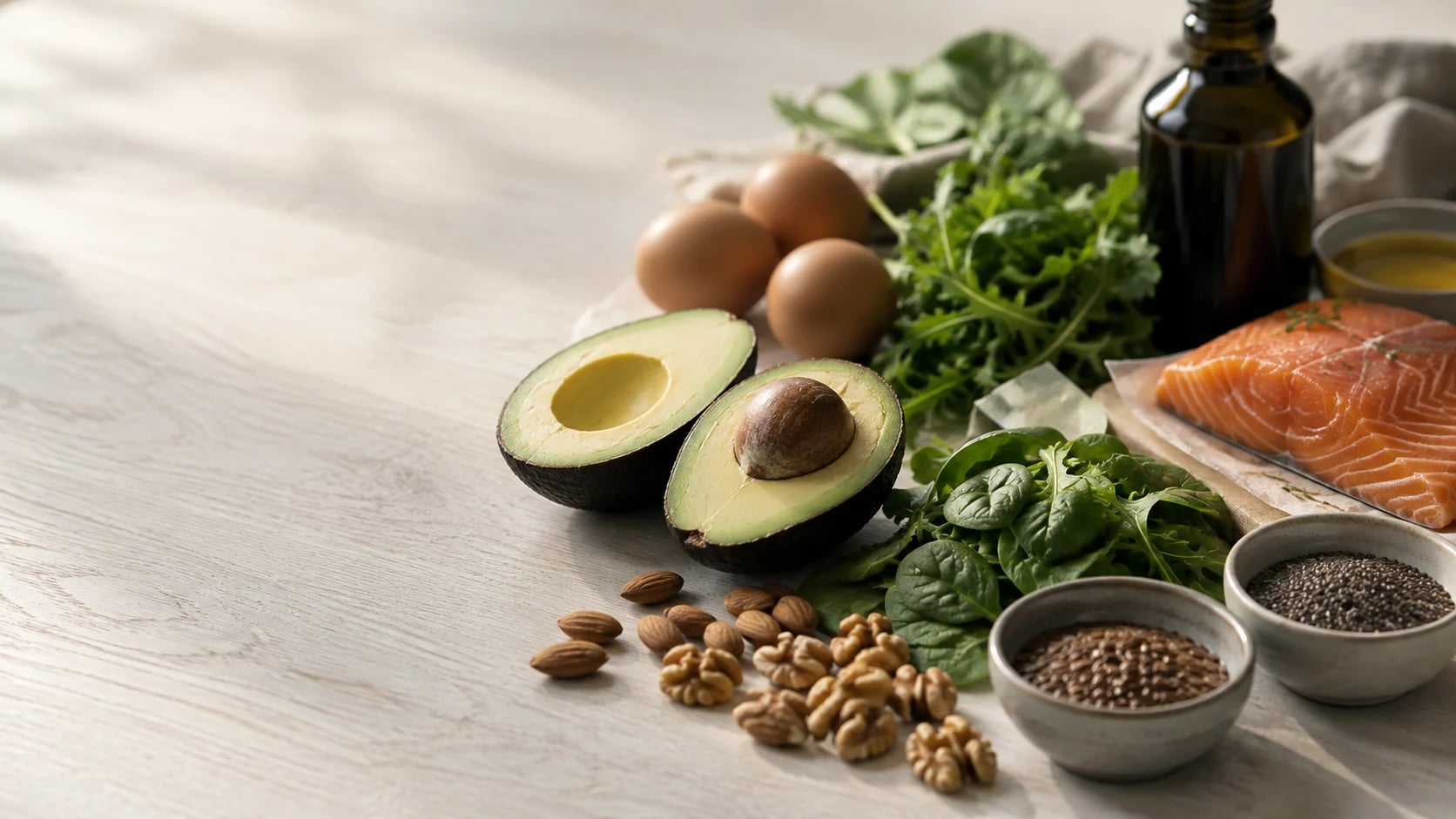
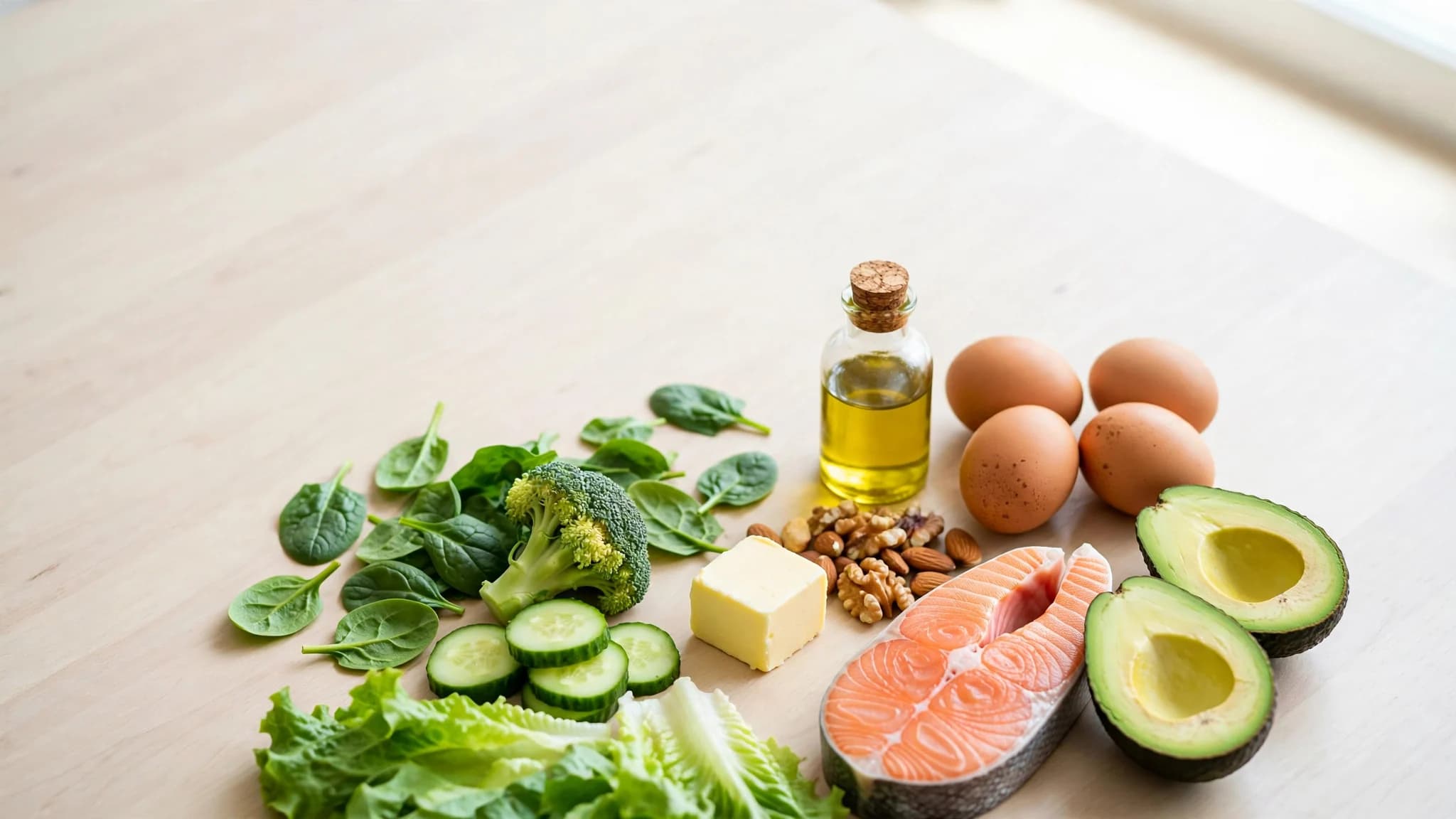
The foundation is fatty fish, eggs, avocado, olive oil, nuts, flax and chia seeds, butter, and cheese. The plate rule helps you avoid counting: half vegetables, a quarter protein, a quarter fats.
Then comes the caveat that is most often overlooked. You don’t “top up to the target” with spoonfuls of oil. If your goal is to lose weight, fat remains a source of calories, and oil, cheese, nuts, and chocolate can easily turn from an addition into several hundred unnoticed kilocalories.
A daily limit, not a mandatory norm
- Nuts 20-30 g
- Chocolate 85% and above 10-20 g
- Added oil 10-20 g
- Nobody needs them every day: this is an upper limit, not a plan
What goes on the plate every day?
There is a short list of foods that the method recommends keeping in the fridge at all times. Not for the sake of exotic ingredients: each one covers something that is easy to fall short of on a low-carb diet.
A large bowl of green salad, 300 g, provides fiber and volume, making the meal feel like food rather than a piece of meat on a plate. The dressing is simple: olive oil, apple cider vinegar, salt.
Half an avocado provides potassium, which is lost along with fluids during the first few weeks. Flax and chia, two to three tablespoons each, provide fiber, without which bowel movements change for most people. Sauerkraut starts at 30 g and gradually increases to 100. Fatty fish several times a week covers omega-3.
Nuts stand apart here: they are healthy, but they have a limit, and it is easiest to exceed it.
Daily Foundation
| Product | How much per day | Why |
|---|---|---|
| Зелёный салат и зелень | до 300 г | объём и клетчатка |
| Авокадо | от половины плода | калий, жиры |
| Лён и чиа | по 2-3 ложки | клетчатка |
| Квашеная капуста | от 30 г, постепенно до 100 | ферментированный овощ |
| Жирная рыба | несколько раз в неделю | омега-3 |
| Орехи | 20-30 г, это потолок | жиры, магний |
How much protein do you need?
From 1.2 to 2 grams per kilogram of body weight. This refers to pure protein per day, not the weight of the meat or fish on your plate.
This is where people get confused most often, so let’s calculate it. A woman weighing 70 kg: 1.2 g per kg gives 84 g of protein, while 1.6 g per kg gives 112 g. If you’re losing weight and working out, a practical target for you is approximately 85–110 g of protein per day. For comparison: 120 g of chicken breast contains about 27 g of protein. One serving covers a quarter of your daily requirement, not all of it.
Protein preserves muscle while your weight is going down and has a stronger effect on satiety than other macronutrients. That’s where you get what this was all about: on a low-carb diet, you usually don’t feel like eating every two hours.
Why do snacks disappear?
There are no snacks at all in this approach. The entire daily diet fits into two or three meals, each until you’re full.
It doesn’t work through willpower. When there’s enough fat and protein on your plate, your blood sugar doesn’t spike, and two hours later you don’t feel drawn to the refrigerator. If you do, the previous meal was most likely too small. That’s the first thing to check before blaming yourself.
How much to drink and what to do about salt?
The guideline for fluid intake is about two liters per day. You need more in hot weather and on training days. If you have kidney or heart disease, the amount is determined by a doctor, not by a table in an article.
In the first weeks, the body excretes more fluid, and salts leave with it. Therefore, the method uses a guideline of 3-5 g of salt per day. An important condition: salt, potassium, and magnesium should not be taken additionally “just in case.” Potassium comes from avocados and greens, magnesium from nuts.
What does a typical day look like?
Первый приём, около 10:00
Белок и жир в основе: яйца с авокадо, омлет с сыром, жирная рыба. Овощи по желанию.
Второй приём, около 13:00
Большая чашка зелёного салата, 300 г, с оливковым маслом, яблочным уксусом и солью. Рядом мясо или рыба.
Третий приём, около 18:00
Такой же по составу, но легче по объёму. После него окно закрывается до утра, между приёмами только вода, чай и кофе без сахара.
Which vegetables are allowed?
The rule is simple: anything that grows above ground. Salad and leafy greens, all types of cabbage, cucumbers, zucchini, broccoli, asparagus, spinach, bell peppers, and tomatoes in reasonable quantities.
Underground vegetables are out: potatoes, beets, large amounts of carrots, and corn. The exception is onions and garlic: they are kept in small amounts, go into almost every dish, and make no noticeable contribution to carbohydrates.
Why divide them this way? Root vegetables store starch—that is, the same fast sugar, only slower to taste. Above-ground vegetables consist mostly of water and fiber, and practically fit into the 50-70 g allowance without counting.
How is this different from keto?
By how strict the boundaries are. Strict keto keeps carbohydrates noticeably lower and monitors the state in which the body switches to ketones. A moderate low-carb diet does not require this level of strictness.
The practical conclusion is that the restrictions of strict keto cannot be mechanically applied to the moderate version. These are different approaches, and they should not be confused either in expectations or in contraindications.
Do you need to fast in this case?
No. Low-carb eating and intermittent fasting are two independent tools.
You can eat few carbohydrates and not fast. You can keep a 12–14-hour overnight break without changing what you eat. You don’t have to combine them, and a stricter regimen doesn’t mean a more correct one.
There is no mandatory progression of “three meals, then two, then one” here. Reducing three meals to two makes sense only when, for several days in a row, one of them really isn’t needed: no weakness, no intrusive thoughts about food, no urge to overeat in the evening. One meal a day is not the goal: with it, it’s noticeably harder to get enough protein, fiber, and micronutrients.
Why aren’t calories counted here?
Because composition matters, not quantity. Calories don’t disappear and still do their work, but with filling meals made of fats, protein, and vegetables, people usually eat less without doing the math.
This isn’t magic or permission to eat without limits. Oil and nuts are still calorie-dense, which is why they have a higher daily cap. The difference is that you don’t need to keep a log: satiety does it for you.
What happens in the first few days?
For some people, the first few days pass unnoticed. Others experience headaches, weakness, drowsiness, and changes in bowel movements.
The reason is straightforward: glycogen is used up, and the water bound to it is lost as well. The rapid drop on the scales during this week is largely water, not fat. The so-called “keto flu” does not happen to everyone and lasts from a few days to several weeks.
Only the first 3 days are difficult. Your mood may drop and apathy may set in. This is the body's temporary resistance.
What helps during these days
Eat properly, drink enough, don’t start with a severe calorie deficit, and don’t add intense workouts.
If your diet used to be low in fat, start with half or a third of the recommended fat portions. Heaviness after lard or bacon means the portion should be halved. Bloating from sauerkraut is treated the same way, and if you’re intolerant to it, replace it with bell pepper dressed with apple cider vinegar.
When should you expect changes?
There is no week-by-week timeline, and it would be dishonest to promise one.
What can be said for certain: in the first few days, some fluid is lost due to reduced glycogen, and weight can sometimes drop quickly. During the first one to two weeks, initial headaches and weakness often subside for many people, if they had them at all.
There is no proven timeline for steady energy and reduced cravings for sweets. For some, this happens quickly; for others, noticeably later; and for some people, there is no significant change in cravings at all. The first noticeable changes in appetite and well-being often appear within one to three weeks, but this is individual and is not a criterion of success.
Where does the swelling go?
Along with glycogen, the body holds water bound to it. When carbohydrates become scarce, glycogen is used up, and the excess fluid leaves.
This means there are two things to understand in advance. First: a quick drop on the scales in the first week is largely water, not fat, and you shouldn’t celebrate it as a result. Second: this is also roughly why your weight then stalls for a while, even though nothing has gone wrong. The water went away once; after that, it’s fat that changes, and it goes away more slowly and not in a straight line.
A face that looks puffy in the morning, rings feeling tight on your fingers, heaviness in your legs by evening — these are things people notice before the number on the scales. These are exactly the signs worth paying attention to; they’re more honest than weighing yourself in the morning.
What about workouts?
You can work out, but don’t start a new training routine on the same day as a new diet.
In the first few days, your body is adjusting: glycogen is used up, the fluid and electrolyte balance changes, and some people experience weakness. If you add an unfamiliar workload during these same days, it will be impossible to figure out what exactly went wrong.
The sensible order is: spend a week to a week and a half on the new diet first, then your usual workload, and then increase it. If you already work out, don’t stop, but don’t expect personal records in the first few days, and keep your protein at the upper end of the range, closer to 1.6 g per kilogram.
What to do after a slip-up?
Do not compensate for it. Return to your usual routine with your next meal.
A common mistake looks like this: you eat dessert at four in the afternoon, decide the day is ruined, eat everything that was in the house, and then don’t eat until evening the next day as punishment. One episode turns into two lost days and an evening of overeating.
The right move is more boring. Dessert at 4:00 p.m. does not cancel the day: the planned dinner remains a regular dinner, followed by the usual overnight break. The answer to the question “how many hours before returning” is not 12, 24, or 36, but with the next normal meal.
What matters is your usual routine over weeks and months, not one episode. This is the only arithmetic that works here.
How to eat out?
At a café, order the same as at home: protein and vegetables. Steak, fish, breaded-free chicken, salad with olive oil. Swap the side dish for vegetables — it’s a normal request, and waiters hear it every day.
The harder part isn’t the food, but the little things around it. Sugar is hidden in sauces, dressings, and marinades, so it’s easier to ask for the dressing separately. The bread basket is removed from the table right away, not «not yet».
The same approach works when visiting someone: eat before leaving so you sit down at the table not hungry. A hungry person at someone else’s table makes decisions without thinking.
Who is this suitable for?
For adults who want to lose weight, reduce swelling, and stop relying on snacks. For those whose day falls apart because of sugar cravings. For those who have already tried counting calories and given up.
This does not mean “suitable for everyone.” Below is a list of conditions in which you must not start on your own.
When this is not suitable
| To whom | What to do |
|---|---|
| Беременность | Строгое ограничение углеводов и голодание не рекомендуются. ADA называет минимум 175 г углеводов в сутки |
| Кормление грудью | Без голодания и строгого кето без согласования с врачом; референс углеводов при лактации выше |
| Диабет 1 типа | Только вместе с врачом: риск гипогликемии и сбитого дозирования инсулина |
| Диабет 2 типа | На инсулине или препаратах с риском гипогликемии режим самостоятельно не меняют |
| Хроническая болезнь почек | Только с врачом или нефрологом |
| Удалённый желчный пузырь | Обычно можно, но жир поднимают постепенно, по переносимости |
| Расстройства пищевого поведения | Жёсткие окна и запреты закрепляют ограничительное поведение, нужен специалист |
| Подростки | Только по медицинским показаниям и под наблюдением врача |
| Пожилые | Не запрещено, но приоритет достаточная калорийность и белок, а не строгость |
Frequent mistakes
- Combining starting with a severe calorie deficit and new workouts on the same day
- Hitting fat targets with spoonfuls of oil for the percentages
- Counting 120 g of chicken as the daily protein allowance
- Eat too little and wonder at your weakness
- Take salt and magnesium “just in case,” without a reason and without a doctor
- Wait for the result based on the calendar from someone else's article
What to do if there are no results?
First, check that you are actually following the plan, rather than merely thinking you are. The explanation almost always comes down to one of four things.
Hidden sugar in sauces and processed foods. Unnoticed calorie additions: a handful of nuts in the evening, an extra spoonful of oil, a piece of cheese “on the go.” Meals that are too small, followed by overeating in the evening. And lack of sleep combined with stress, which can keep your weight from changing despite an ideal diet.
There is also a fifth reason that is usually considered last: there are results, but they are being measured incorrectly. Your weight may not change over the course of a week while your measurements decrease. A measuring tape and your clothes are more honest.
If none of this applies and you are feeling worse, that is a reason not to “push harder,” but to see a doctor.
Frequently Asked Questions
Можно ли есть фрукты?
Сладкие фрукты уходят, ягоды в небольшом количестве в норму 50-70 г помещаются. Смотри на общее количество углеводов за день, а не на отдельный продукт.
Обязательно ли покупать что-то особенное?
Нет. Зелень, яйца, жирная рыба, оливковое масло, авокадо и орехи продаются в обычном магазине.
Что делать при срыве?
Ничего не компенсировать. Вернуться к обычному режиму со следующего приёма пищи. Десерт в 16:00 не отменяет день: запланированный ужин остаётся обычным ужином. Решает привычный режим за недели и месяцы, а не один эпизод.
Можно ли тренироваться?
Да, но не начинай новый режим тренировок в один день с новым питанием. Первые дни тело и так перестраивается.
Нужны ли добавки?
Нет, если врач не сказал иначе. Калий берётся из авокадо и зелени, магний из орехов.
What to do tomorrow morning
Убери с кухни
Сахар, хлеб, крупы, картофель, сладкие напитки. Пока это лежит на полке, решение принимается заново каждый вечер.
Купи основу
Зелень и салат, авокадо, яйца, жирную рыбу, оливковое масло, орехи.
Собери один день
Три приёма пищи в окно 8-10 часов, в каждом белок и овощи, между ними ничего. Один день, не неделю: дальше станет понятно, чего не хватает в холодильнике.
Blog sections
The topic breakdown is covered in five sections.
Low-carb nutrition basics — carb allowance, the share of fats and protein, and how it differs from keto.
Getting started and the first month — what to remove, what to buy, and how to get through the first days.
Food and shopping — lists, superfoods, and hidden sugar in the ingredients.
Menus and recipes — dishes for two or three meals and a salad for every day.
Body and well-being — energy, sleep, swelling, and cravings for sweets.
There are also two separate materials: Anastasia Zhukova's method — how the system looks as a whole, and intermittent fasting — a second, independent tool.